



MgO Board for Ceilings: Benefits, Limitations, and Selection Factors
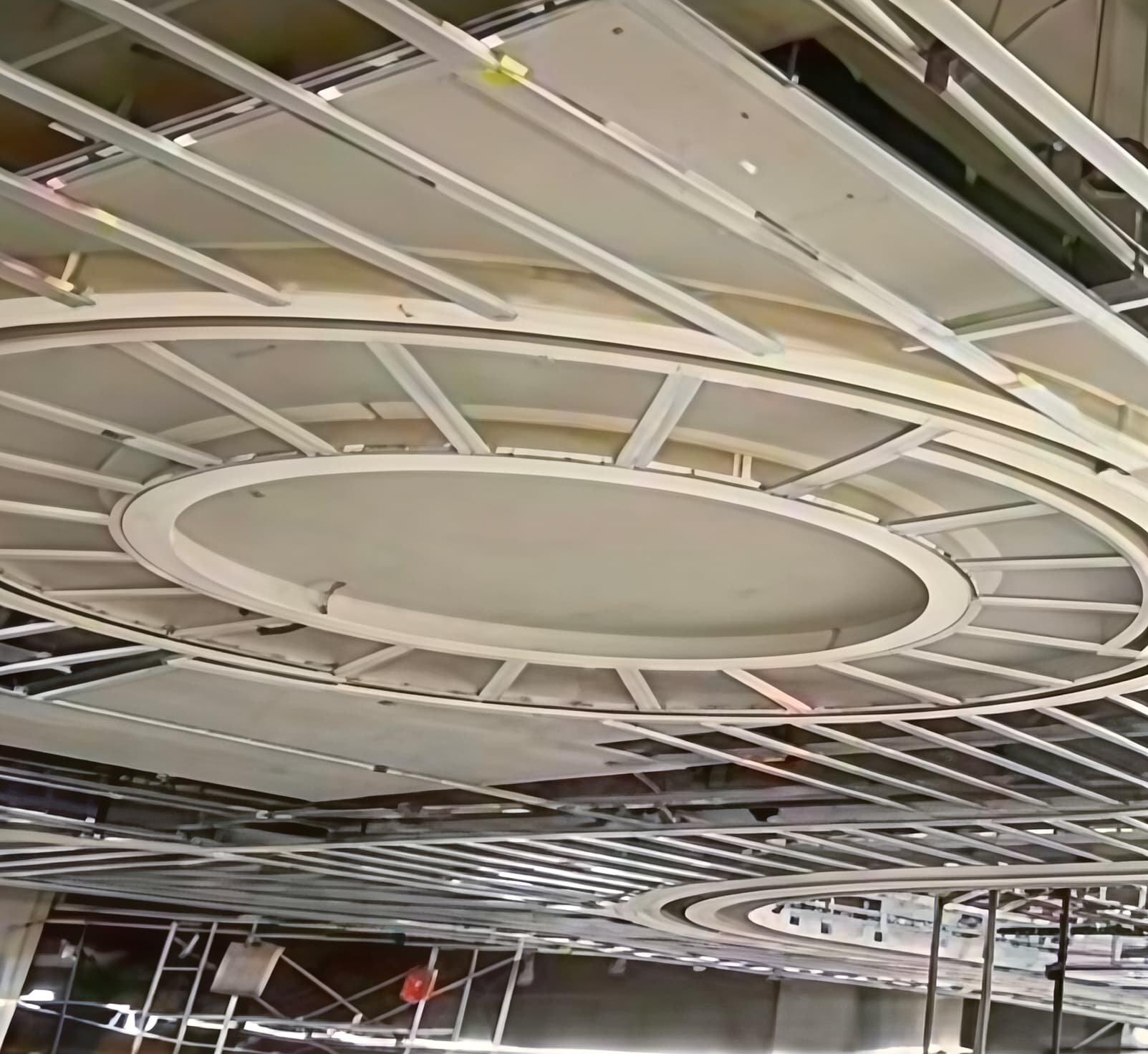
A ceiling board survives conditions the wall never sees. It carries its own weight plus insulation and services above it, it sits in the hottest and dampest air in the building, and it is the surface occupants look at every day. MgO board for ceilings answers most of those demands in one panel: it is non-combustible, dimensionally stable in humid air, and hard enough to take an impact without spalling. It is also denser than drywall and costs more per square meter, so the decision is not automatic.
This guide sets out what MgO board for ceilings does well, where it creates problems on site, and how to specify thickness, span, ratings, and fasteners so the finished assembly performs the way it was tested. It closes with a direct comparison against gypsum board and fiber cement board.
Key Takeaways
MgO board for ceilings combines Class A1 non-combustibility with low water absorption, so one panel covers fire-rated and humid ceilings at the same time.
It is denser than gypsum, roughly 2.3–2.8 lb/ft² at 12 mm, which changes hanger spacing and handling on overhead work.
Fire-resistance ratings belong to the tested assembly, not the board, so ASTM E119 or UL 263 documentation has to match the build-up.
Standard formats run 1220 mm wide and 2440–3050 mm long, with thicknesses from 5 to 30 mm; ceiling work typically uses 8–12 mm.
Specify by span, fastener type, and surface finish, and confirm Class A1 and E0 certificates before ordering.
MgO Board Ceiling Benefits
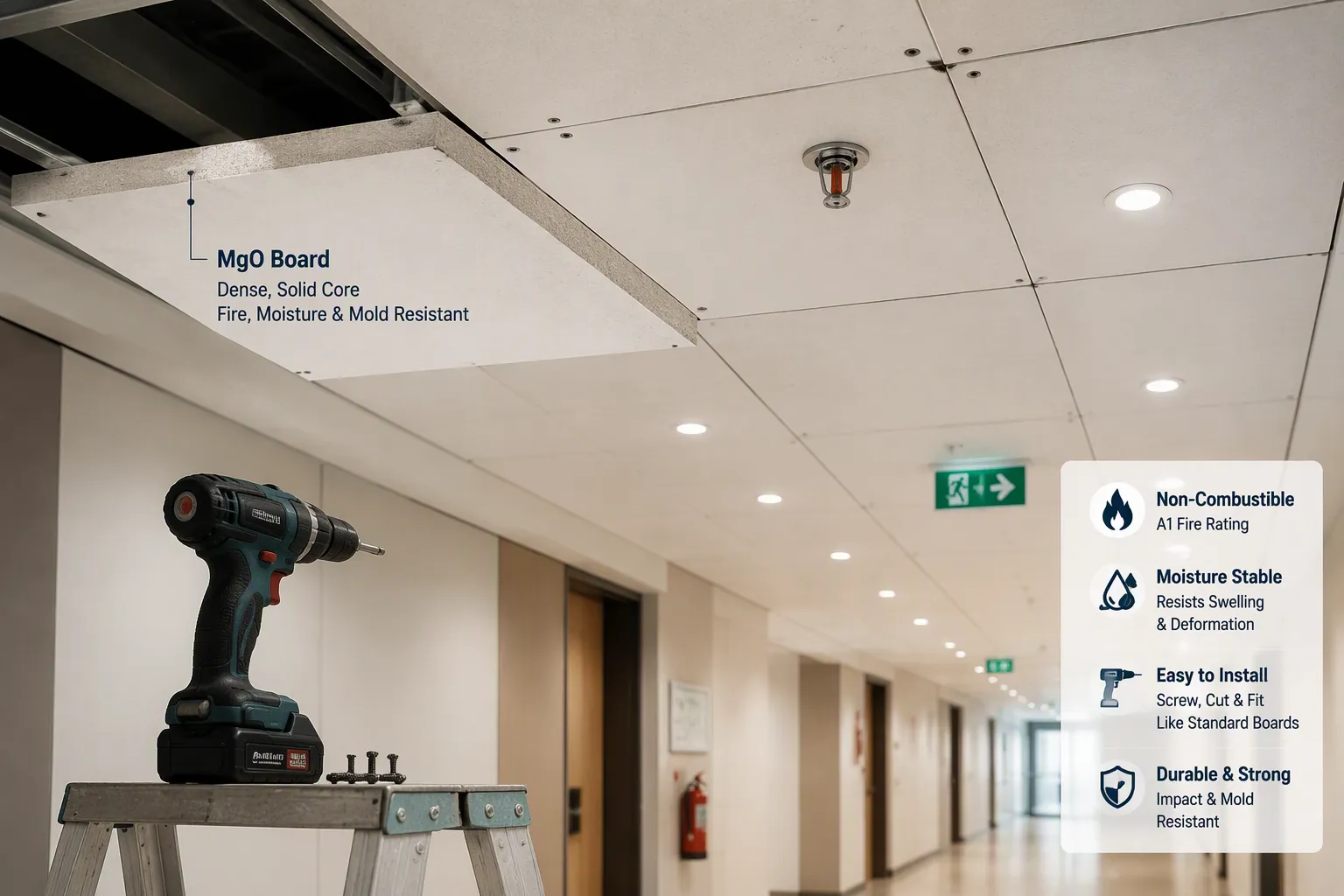
Three properties drive most ceiling specifications: reaction to fire, behavior in humid air, and resistance to impact. MgO board for ceilings performs well on all three because its core is inorganic and dense. The sections below explain what each property means for a real ceiling assembly.
Fire and Moisture Resistance
Massif MgO board carries a Class A1 rating under EN 13501-1, the highest class in the European reaction-to-fire classification. A1 means the material contributes essentially nothing to a fire: no sustained flaming, negligible heat release, and no burning droplets. The board also meets ASTM E136 non-combustibility, the test that decides whether a material can be classed as non-combustible inside a building assembly.
Surface burning behavior is measured separately. Under the ASTM E84 surface burning test, MgO board for ceilings returns a flame spread index of 0 and a smoke developed index of 0 in supplier testing, which places it well inside Class A limits. In practice that means a kitchen ceiling or an exit corridor gains time, because the board neither feeds the fire nor adds smoke to the escape route. The board is formaldehyde-free and meets E0 grade emission requirements, the low-emission grade defined in Chinese national standard GB/T 39600-2021 and commonly requested in Asian and Middle Eastern projects.
Fire endurance is a different question from reaction to fire. A floor-ceiling or roof-ceiling assembly built with MgO board can reach up to four hours, but only for the exact build-up that was tested: the same board thickness, the same framing, the same fasteners, and the same cavity insulation. Change one component and the rating no longer applies to the assembly.
Moisture performance is the second reason specifiers look at MgO board for ceilings. Water absorption is reported at about 0.34%, against roughly 3% for standard gypsum board. The core is inorganic, so it offers mold and mildew nothing to feed on, and it does not swell, soften, or delaminate under normal humidity. Bathroom ceilings, pool halls, laundry areas, and unheated plant rooms all stay stable.
That stability carries into the finished ceiling. A gypsum ceiling in a humid room often sags between fasteners and shows a shadow at every joint once the paper face has taken on moisture, and the repair is a full re-skim. MgO board for ceilings keeps its dimensions, so the joint line stays where it was built and the finish coat does not have to be redone after the first wet season.
The board is vapor-permeable, so moisture that enters the assembly can dry outward instead of being trapped behind a vapor-tight face. That matters on ceilings below a cold roof deck, where interstitial condensation is a common cause of staining and joint failure. One caution: low water absorption is not the same as waterproof. MgO board for ceilings handles humid air and occasional wetting, but it does not replace a drained and ventilated roof build-up, and standing water on an unsealed board should never be treated as harmless.
Strength and Stability
Impact resistance is where density pays off. Massif reports 7.5 kJ/m² for its ceiling boards, a figure above typical gypsum board and comparable to or above fiber cement. On a ceiling that people can reach, such as a gym, a corridor, a school hall, or a service tunnel, that margin decides whether the surface survives a trolley strike or a ball.
The same toughness applies to what happens above the ceiling. Trades working in the plenum step on the board while running cable or duct, and a panel that cracks under a boot leaves a hole that has to be patched from below. A dense MgO board for ceilings takes that incidental load better than a paper-faced panel, which is one reason it turns up in plant rooms and service corridors as well as in occupied spaces.
Impact figures need context to be useful. A kJ/m² result depends on the test rig, the specimen support, and the strike energy, so two suppliers can quote the same number from different methods and mean different things. Ask for the test report behind the headline value, and check whether the figure describes a bare panel or a finished assembly with joints and skim coat. For MgO board for ceilings, the assembly figure is the one that predicts how the finished surface behaves.
Apparent density runs 0.95–1.15 g/cm³. The dense inorganic core holds its shape across humidity and temperature swings, so joints stay tight and screw heads stay seated. Thickness swelling and linear expansion stay low, which is why cracked joints and popped fasteners are less common than on moisture-sensitive boards.
Workability belongs to the same story. Crews can saw, drill, screw-fix, laminate, and paint MgO board for ceilings with standard tools. The face accepts transfer printing for decorative ceiling finishes, so a project can carry a pattern without adding a separate ceiling tile system.
Indoor air quality completes the case. The board is naturally sourced and non-toxic, which makes MgO board for ceilings a sensible choice for occupants with allergies, asthma, or chemical sensitivity. The ceiling then supports air quality for the life of the building rather than off-gassing through its first year.
MgO Board Ceiling Limitations
MgO board for ceilings is not a drop-in substitute for drywall, and treating it as one is where most site problems start. The limitations below are the ones that change cost, labor, or sequencing on a real ceiling project, and each of them can be priced before the board is ordered.
Weight and Installation
Weight is the first practical concern, and it is the one that most often forces a design change after the board has already been chosen. MgO board for ceilings is denser than standard gypsum board, and density translates directly into load on the hanger system.
The table below gives typical figures at 12 mm. Density values come from manufacturer data; weight is calculated as density × thickness and converted at 1 kg/m² = 0.2048 lb/ft².
| Material | Typical density (g/cm³) | Weight at 12 mm (kg/m²) | Weight at 12 mm (lb/ft²) |
|---|---|---|---|
| Gypsum board | 0.70–0.99 | 8.4–11.9 | 1.7–2.4 |
| MgO board | 0.95–1.15 | 11.4–13.8 | 2.3–2.8 |
| Fiber cement board | 1.3–1.5 | 15.6–18.0 | 3.2–3.7 |
At 12 mm, MgO board for ceilings lands between gypsum and fiber cement: heavier than drywall, noticeably lighter than cement board.
Two consequences follow. First, handling: a 1220 × 2440 mm panel at 12 mm weighs roughly 33–40 kg (73–89 lb), so two-person lifts are the norm and a mechanical lifter pays for itself across a large ceiling area. Second, framing: hanger spacing, main runner size, and cross-tee capacity all have to be checked against the calculated ceiling load rather than assumed from a drywall layout.
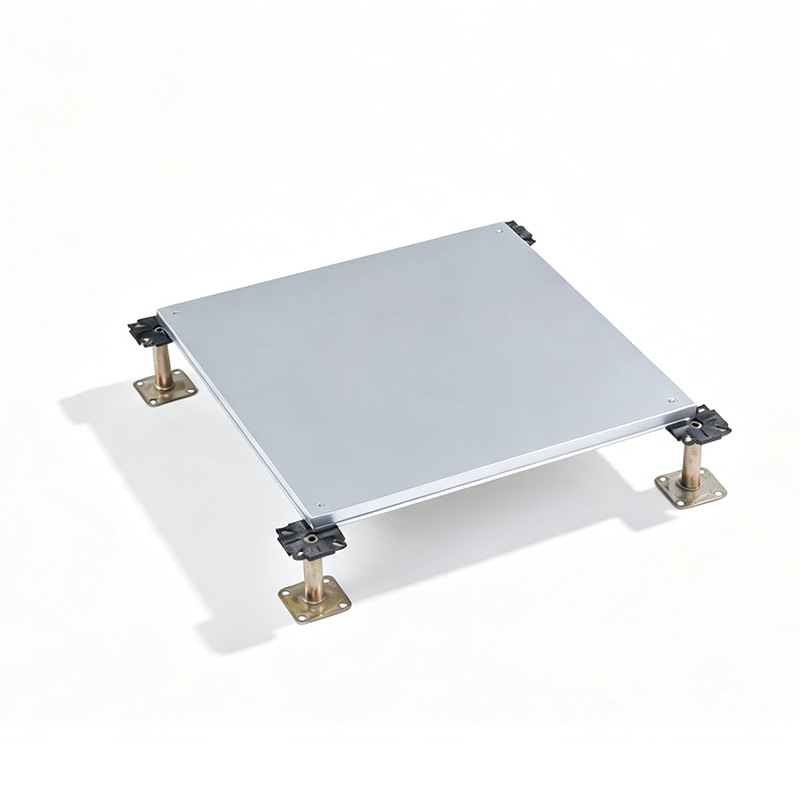
The fixing method decides how much of that weight matters. A suspended grid carries MgO board for ceilings in a tee system, so the board only has to span between tees and the grid takes the load to the hangers. Direct fixing transfers every panel to the joists or studs, which is why the fastener schedule and the framing member size have to be verified against the board weight rather than copied from a drywall detail.
Fastening demands care as well. Edge screws sit at 150–200 mm spacing and field screws at 250–300 mm, with 10–12 mm edge clearance to avoid splitting the core. Longer screws suit overhead work because they reach through thicker build-ups, and temporary props hold each panel until every screw is seated.
Joint treatment is the hidden labor item. Joints and fasteners need patching, leveling, and skimming before finishing, and MgO board for ceilings takes that prep work like any cementitious surface: slower than paper-faced drywall, and less forgiving of a rushed second coat. Cutting needs the right blade, steady support, and dust control, because the cut edge is abrasive.
A chloride-free formulation is the specification that protects the finished ceiling over time. Excess chloride in an MgO panel draws moisture from the air and drives corrosion of steel framing and fasteners, which shows up as rust staining on the board face months after handover. Massif holds chloride ion at or below 0.01% on its ceiling boards, and the test report for the batch is the document that proves it. Buyers who skip that check inherit a ceiling that behaves well in the sample room and badly on site.
Cost and Handling
Cost is the second limitation. MgO board for ceilings carries a higher unit price than standard gypsum board, and the extra labor for joint treatment widens the gap. The comparison only becomes fair when the alternative is a moisture-resistant or fire-rated gypsum assembly with additional layers, because that build-up closes much of the price difference.
Edge fragility is a handling issue that shows up in freight claims rather than on drawings. Corners chip or crumble under impact or strapping pressure, so boards should travel on edge and stay protected in storage. Cutting generates dust that may be harmful if inhaled: safety goggles, a dust mask, and gloves are basic equipment, cut edges should be smoothed before installation, and a vacuum attachment on the saw keeps the work area cleaner.
Formulation quality varies widely in this category, which is why MgO board for ceilings from two suppliers can meet the same nominal specification and still behave differently on site. Buyers should request test documentation and confirm standards compliance before committing, because two boards sold under the same name can differ in density, chloride content, and fire performance. That check protects both the budget and the performance expectation.
Need MgO board for ceilings that matches your span, rating, and finish schedule?
Get a QuoteSelecting MgO Board for Ceilings
Specifying MgO board for ceilings comes down to four decisions made in order: the assembly, the board, the fixing, and the documentation. Getting them in that sequence avoids the common failure where a board is chosen first and the assembly is reverse-engineered around it.
Thickness and Span Rating
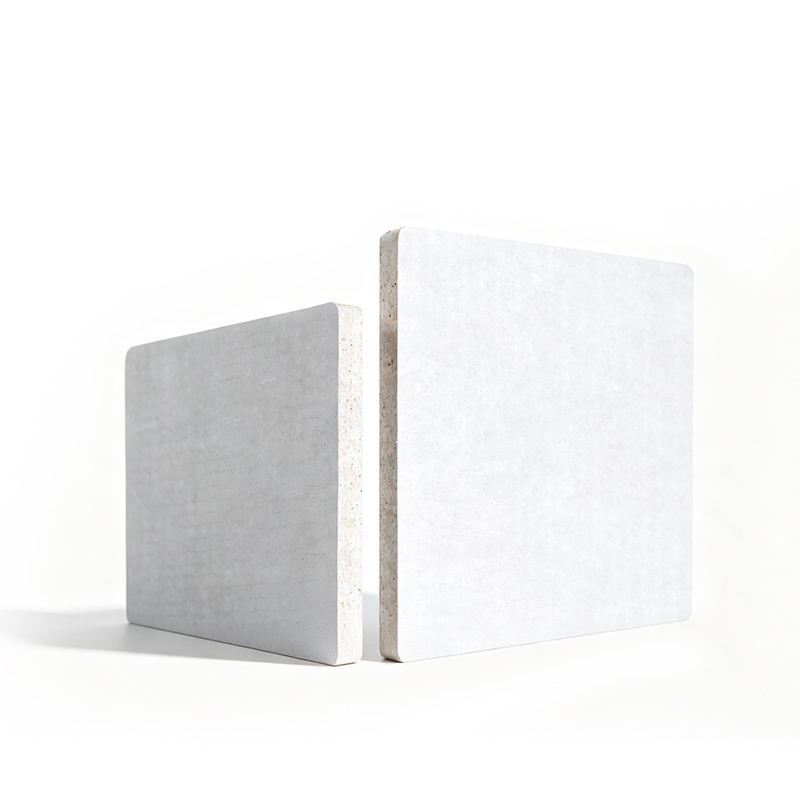
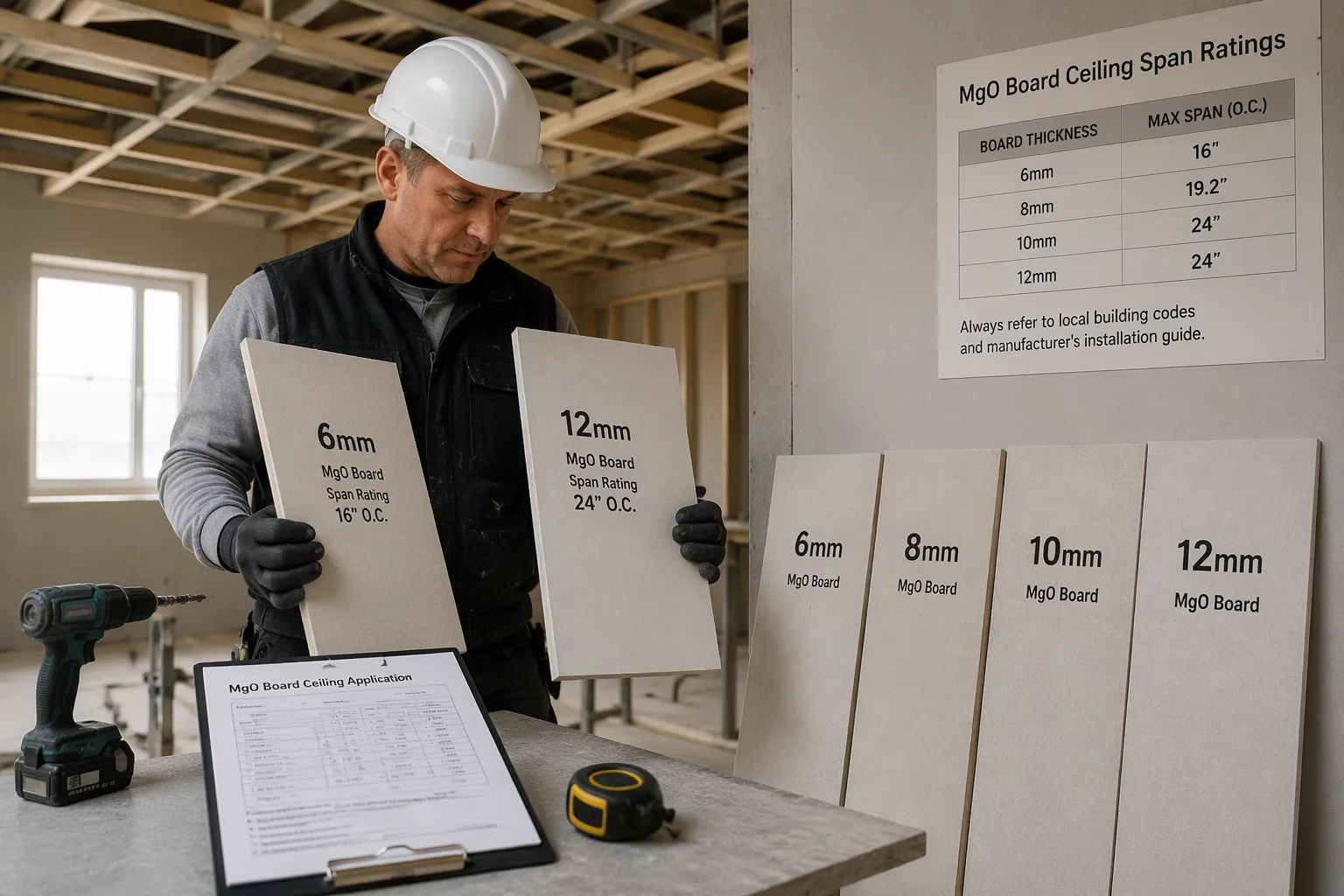
Board size drives both waste and installation speed. Massif MgO board comes in standard lengths of 2440, 2700, and 3050 mm at a width of 1220 mm, with thicknesses from 5 to 30 mm. Longer panels span more framing and leave fewer joints to finish, which is usually worth more than the handling penalty on a large ceiling.
For ceiling work the recommended thicknesses are 8, 9, 10, and 12 mm. Thin panels suit suspended ceilings where a grid carries the board and handling overhead is the main constraint. Fastened ceilings over wood or light gauge steel framing call for 12 mm or thicker, because countersunk screws need enough core depth to hold without breaking through, and because the board has to bridge framing at the specified spacing without visible deflection.
Panel joints drive the layout as much as thickness does. On a suspended ceiling, MgO board for ceilings is normally laid with the long edge across the main runners and joints staggered from one course to the next, so that no four corners meet at a single point. A 3050 mm panel cuts to a 1220 mm module with little waste, while a 2440 mm panel suits rooms that run on a 1200 mm grid. Ordering the longest panel the lift and the stair core can take is usually the cheapest decision on a large ceiling, because every joint removed is a joint that does not have to be taped, skimmed, and sanded.
Span rating deserves equal attention. A load-bearing ceiling needs a review of design loads, support spacing, deflection limits, fastening pattern, moisture conditions, and usage intensity. Massif supplies application-specific boards chosen by building position, load condition, and processing method, and technical support can confirm the recommended product, thickness, surface, edge, and test documentation before purchase.
Three ceiling types use MgO board for ceilings for different reasons, and each sets its own priorities:
Suspended ceilings on a metal grid: the thinner 8–10 mm panels suit the system, and the main question is board weight against grid capacity.
Direct-fixed ceilings on timber or light gauge steel: 12 mm or thicker, with a screw schedule and framing size confirmed against the span.
Exterior soffits and roof linings: 12 mm or thicker with sealed edges, because wind-driven rain and UV exposure act on the underside of the building.
Ratings, Framing, and Cost
Rating documentation protects the whole assembly, not just the board. Confirm Class A1 non-combustible and E0 grade certificates first, then match the rating to the ceiling type.
Three test standards come up on almost every ceiling project that specifies MgO board for ceilings, and each answers a different question:
EN 13501-1 classifies the material itself, and A1 is the top class in that system.
ASTM E84 reports flame spread and smoke developed for the finished face.
ASTM E119 or UL 263 rates the complete assembly in hours, not the board.
A supplier who can produce all three for the same product line has done the work that a substitution review later would otherwise require.
Fire-rated ceilings need assemblies tested to the ASTM E119 fire test or UL 263, which measure how long a floor-ceiling or roof-ceiling system resists fire spread under a standard time-temperature curve. Finish materials are judged separately: ASTM E84 covers flame spread and smoke development, and the ASTM E136 non-combustibility test covers the combustibility of the material itself. Bathroom ceilings lean on moisture performance instead, where the relevant evidence is water absorption, dimensional change, and mold resistance.
Model codes such as the NFPA 101 Life Safety Code and the International Fire Code set the baseline for commercial and residential work, and local authorities may add requirements on top. An assembly that satisfies ASTM E119 still has to be accepted by the authority having jurisdiction on the project.
Framing and fastener compatibility come next. Confirm that the board works with the planned framing type and screw type, and check surface options (non-woven and sanded) plus edge details against the finish schedule. A sanded face takes paint and skim coats differently from a non-woven face, and the edge profile decides how joints are treated.
On a suspended grid, the screw type matters as much as the spacing. Self-drilling screws with a fine thread suit light gauge steel runners, coarse-thread screws suit timber, and either must be long enough to pass through the board and engage the framing without stripping. Where MgO board for ceilings is fixed to a metal frame in a humid space, specify coated or stainless fasteners so that the fixing does not become the weak point in an otherwise corrosion-resistant assembly.
Cost closes the decision. Weigh board price against waste reduction, installation speed, and the test documentation each project requires. A board that arrives with a complete test package can save a substitution review later, and that saving often outweighs a small unit-price difference.
One more check belongs on the list: the storage and handling plan. MgO board for ceilings should be stacked flat on a dry, level surface, kept clear of standing water, and lifted rather than dragged on site. Boards stored on edge without support bow, and bowed panels show as a wavy ceiling once they are screwed up.
| Factor | MgO board | Gypsum board | Fiber cement board |
|---|---|---|---|
| Fire performance | Class A1 non-combustible | Rated assemblies available | Non-combustible |
| Moisture resistance | Water-resistant, mold resistant | Moisture-resistant grades only | Highly moisture resistant |
| Impact strength | 7.5 kJ/m² reported | Lower | Moderate to high |
| Typical fit | Fire-rated, humid, high-impact ceilings | Dry interior ceilings on budget | Wet areas needing durability |
| Cost | Higher | Lower | Moderate to higher |
Each option fits a different ceiling. Gypsum board serves dry interior ceilings at low cost. Fiber cement board handles wet areas with durability and a familiar cementitious finish. MgO board for ceilings covers fire-rated, humid, and high-impact assemblies where its ratings justify the price.
Moisture-Resistant MgO Ceiling Board
A non-combustible MgO board for ceilings in suspended fireproof systems, with chloride ion at or below 0.01%.
View Product
Ceiling and Roof Lining Solution
Lining boards, edge details, and fixing guidance for interior ceilings and roof soffits.
View ProductHave an MgO board for ceilings specification in hand? Massif can review the build-up against its test data.
Contact UsConclusion
MgO board for ceilings delivers Class A1 fire performance, low water absorption, 7.5 kJ/m² reported impact strength, and stable dimensions. Weight, higher cost, and careful installation remain the trade-offs, and none of them is hidden.
Choose it for moisture-prone, fire-rated, or high-impact ceiling assemblies. Gypsum board fits dry interior ceilings on tight budgets, and fiber cement board suits wet areas that need durability without a fire rating. When the ceiling has to hold a rating, stay flat in humid air, and take a knock, MgO board for ceilings is the option that does all three.
Before ordering, confirm five things:
Thickness within the 5–30 mm range, matched to framing and span
Span rating and support spacing for load-bearing ceilings
Class A1 and E0 test documentation for the assembly
Framing and fastener compatibility, plus surface and edge options
Total cost, including waste, installation speed, and labor
If you are sourcing MgO board for ceilings for a project in Europe, the Middle East, or Southeast Asia, Massif can supply the board, the test package, and the technical review that goes with it.
FAQ
Is MgO board heavier than gypsum board?
Yes. At 12 mm, MgO board for ceilings weighs about 2.3–2.8 lb/ft² (11.4–13.8 kg/m²), against roughly 1.7–2.4 lb/ft² (8.4–11.9 kg/m²) for gypsum at the same thickness. The gap is modest per square meter but multiplies across a large ceiling, so plan two-person lifts and confirm hanger capacity before installation begins.
Can MgO board go on a bathroom ceiling?
Yes. Water absorption is reported near 0.34%, and the inorganic core resists mold, mildew, and rot. The board does not swell under normal moisture exposure, which is why bathroom ceilings rank among its strongest applications. Ventilation is still required: the board resists moisture, it does not remove it.
Does the fire rating cover the whole ceiling assembly?
No. The rating belongs to the complete assembly, not the board alone. Fire-rated ceilings need systems tested to ASTM E119 or UL 263, and the tested build-up has to match your design: same thickness, same framing, same fasteners, same insulation. Confirm the assembly number before you specify it.
Which thickness works for a ceiling?
Massif MgO board for ceilings ranges from 5 to 30 mm, and ceiling work typically uses 8, 9, 10, or 12 mm. Suspended ceilings on a grid accept the thinner panels. Fastened ceilings over wood or light gauge steel generally need 12 mm or more so countersunk screws hold. Confirm the span rating with technical support first.
Is MgO ceiling board the same as magnesium oxide ceiling board?
Yes. MgO ceiling board and magnesium oxide ceiling board are two names for the same product: a cementitious panel with a magnesium oxide core and a reinforcing mesh, sold for ceiling and roof lining use. Suppliers use both spellings, so specifications and purchase orders should list thickness, dimensions, and the required test standards rather than relying on the name alone.
What should buyers verify before ordering?
Request Class A1 and E0 test documentation, confirm framing and fastener compatibility, and check surface and edge options against the finish schedule. Verify thickness, span rating, and total cost including waste and labor. Massif can generate batch records covering raw materials, formulas, dimensions, and inspection results for each order.