



What Should Buyers Check in an MgO Board Test Report?

A supplier sends a certificate and says the board is tested and certified. That paper only helps when you know what to look at. Three checks matter most. First, confirm the report's scope and the lab's accreditation. Second, read the flexural strength and density values. Third, verify the fire rating matches the class the supplier claims. This guide walks procurement professionals and builders through each step in plain language. No engineering degree is required. The sections below show what a real report contains and where weak documents fall short, so buyers check the right details before placing an order.
Key Takeaways
Confirm the report matches your exact board thickness and density.
Check that the lab holds recognized accreditation like IAS or UKAS.
Read flexural strength and density values at the thickness you order.
Verify the fire rating covers the full assembly, not just the bare board.
Request full test reports with batch traceability, not summary certificates.
What Buyers Check First: Scope and Accreditation
Match Report to Product
A test report only protects a buyer when it describes the exact board being purchased. The document must name the product, the thickness tested, and the batch or formulation behind the sample. A 10 mm board at 1000 kg/m³ behaves differently from a 10 mm board at 1200 kg/m³, so a report for the denser version does not cover the lighter one. For CCMC-assessed products, the CCMC number printed on the board must match the number in the assessment report.
The table below lists the matching checks that matter most.
Verification Check | What the Buyer Must Confirm |
|---|---|
Fire test report match | Test standard used, the exact board thickness tested, and the board density tested |
Sample specification | Thickness, density, surface treatment, edge type, and reinforcement match the order |
Production consistency | Written confirmation that the sample batch formula will be used for mass production, plus density, thickness, and moisture content tolerance ranges |
Pre-shipment inspection | Third-party inspection before loading: random thickness and density checks, packaging integrity, and batch numbers verified against records |
Reports should also state the sample's curing history and exposure time. Flexural-strength reports need board orientation, conditioning, and specimen count, and strength should be compared at the actual ordered thickness.
Verify Lab and Standards
The testing laboratory must hold recognized accreditation, such as IAS, A2LA, or UKAS. The report should show the full standard number, the test edition, the accredited lab details, the specimen description, and a validity date. The cited method must fit the application: ASTM C1186 for physical properties, ASTM E84 for surface burning, or EN 13501-1 for European fire classification.
Timing deserves scrutiny too. A report dated only weeks after a formulation change is worth questioning. Buyers check dates against the supplier's change history, then request recent reports, production specifications, and batch inspection records before approving a shipment.
Review Mechanical Properties
Flexural Strength and Density
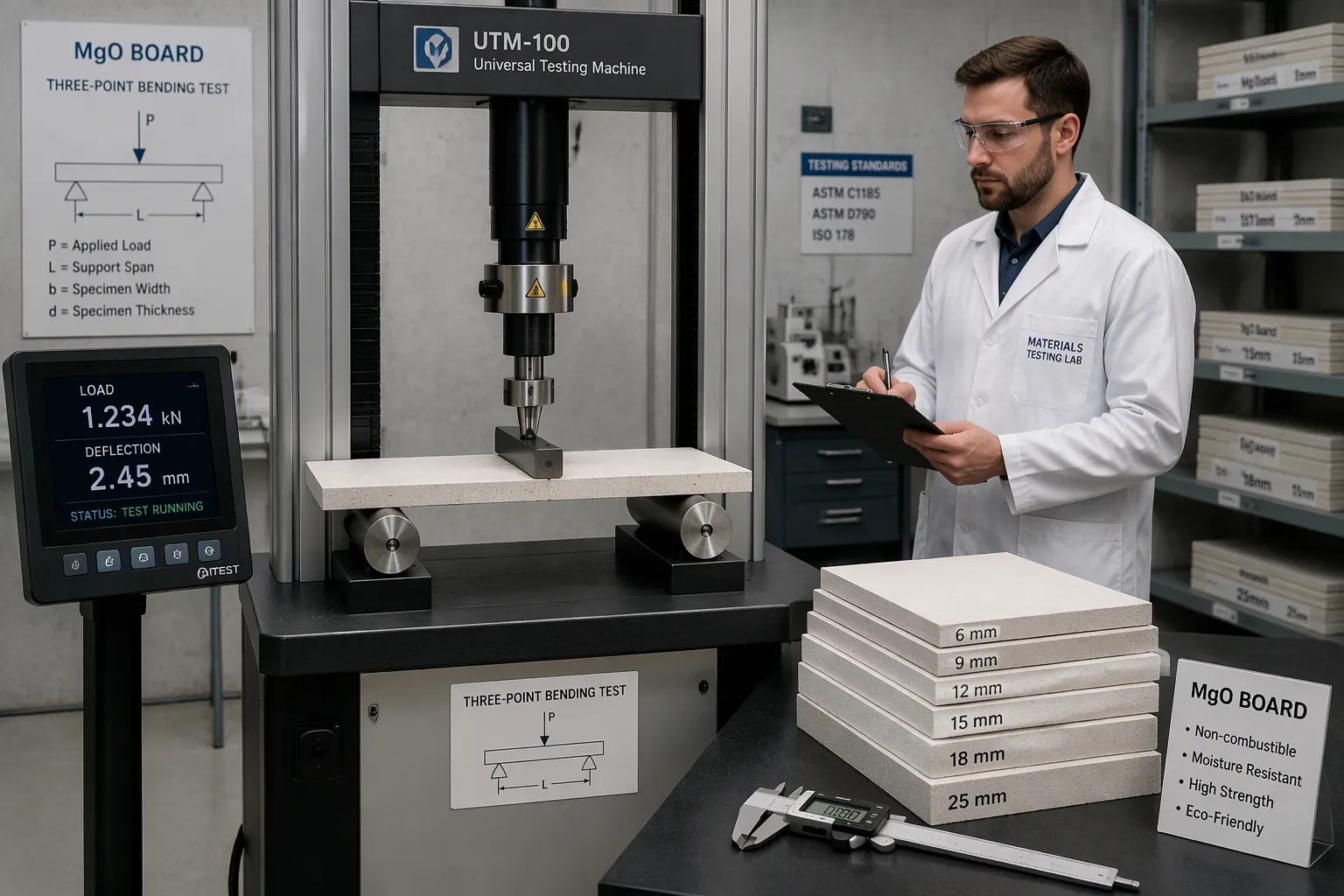
Flexural strength measures how much bending force a board carries before it cracks. Think of a shelf spanning two supports: the load pushes down, the board flexes, and the top face stretches while the bottom face compresses. Flexural strength tells you how much of that stretching the board survives. Density measures mass per unit volume. A denser board generally packs more material into the same thickness, which usually supports higher strength and better dimensional stability.
These two values work as a pair. ASTM C1186 sets performance criteria for fiber-cement boards, including flexural strength, thickness tolerances, and density, and its Type B Grade III category closely matches MgO board properties. ASTM C1185 defines the test methods for bending, water absorption, and dimensional stability. A board that complies with both resists cracking, stays flat, and holds its strength under normal construction loads. Those traits matter for interior partitions, exterior cladding, and floor underlayment, where mechanical reliability decides whether a joint opens or a tile cracks.
MgO board should be both stronger and more water resistant than gypsum board in comparable applications. That combination suits wet areas, basements, and exterior sheathing, where gypsum board needs extra protection. Gypsum board still fits dry interior walls well and costs less in many markets. The point is matching the board to the exposure, not ranking materials in the abstract.
For subfloor or load-bearing uses, buyers check more than strength numbers. The report or accompanying datasheet should state thickness, panel dimensions, and edge profile. A tongue-and-groove edge distributes load across the joint differently from a square edge, and the test data should reflect the profile being shipped.
Impact and Fastener Pull-Through
Bending tests describe slow, steady loads. Real buildings deliver sudden ones: a door slamming, a cart hitting a wall, a dropped tool on a floor. Impact resistance data shows how the board handles that energy without cracking or punching through. Fastener pull-through data shows how much force a screw head needs to tear through the board face. Both values guide fixing spacing and tell installers whether standard screws and washers will hold.
Ask for these results at the ordered thickness. Impact and pull-through performance change with thickness and density, so a report for a thin panel does not describe a thick one. Buyers check that the tested specimen matches the purchase order before accepting the numbers.
Verify Fire and Durability Results
Fire Resistance Ratings
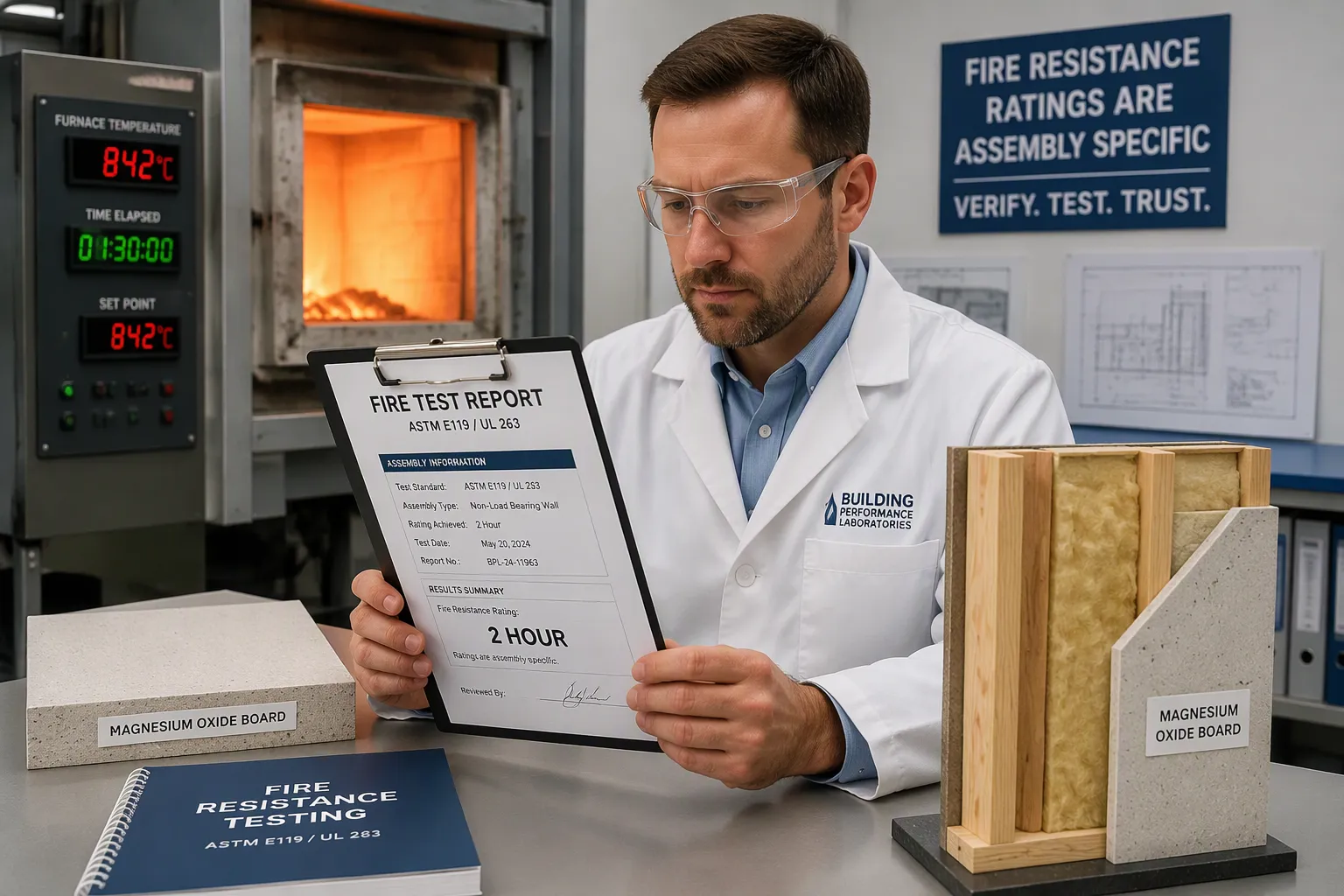
A fire report deserves a structured review. Buyers check seven items: product identity, test method, laboratory, result, assembly scope, limitations, and traceability. Skip any one of these and the document can mislead. Product identity ties the result to the exact board. Test method and laboratory establish credibility. Result and assembly scope define what was proven. Limitations and traceability show where the finding stops applying.
The most common misreading involves scope. A rating earned by a bare board does not describe a finished wall, duct, or floor. The table below shows the difference.
Aspect | Bare-board rating | Assembly-specific rating |
|---|---|---|
What is tested | The board specimen alone | The complete build-up: joints, supports, openings, penetrations |
What it certifies | Properties of the board product | Performance of the full construction |
Scope limitation | Does not cover untested joints or penetrations | Describes permitted details of the evaluated system |
A fire rating is not assigned to a single board. It applies to the entire assembly — framing, insulation, fasteners, and board together. A one-hour or two-hour rating from ASTM E119 or UL 263 therefore belongs to the tested wall design, not to the panel in isolation. A supplier who quotes an hourly figure for bare board is stretching the evidence. The distinction protects the buyer from a costly assumption.
Reaction-to-fire results follow a different path. EN 13501-1 sorts materials into Euroclasses, and A1 marks the highest non-combustible class. The A1 criteria are strict: temperature rise of no more than 30°C, mass loss of no more than 50%, and a gross calorific potential below 2.0 MJ/kg. ASTM E84 measures flame spread and smoke developed, with Class A requiring a flame spread index below 25. Class B runs from 25 to 75, and Class C sits above 75, so the class letter carries real weight. MgO boards commonly post a flame spread of 0 and smoke developed of 5, the best possible result. ASTM E136 confirms non-combustibility. Match the standard to the market and the application before accepting a claim.
Moisture and Freeze-Thaw
Water exposure decides whether a board survives a wet room, a facade, or a cold-climate exterior. Moisture-related tests typically cover water impermeability, water vapor permeability, and resistance to heat and rain with thermal shock. EN 12467 provides the common framework. Under that standard, a Category A result means no water penetration after 24 hours of exposure. Vapor permeability data matters too, because a board that traps moisture inside a wall creates problems elsewhere.
Freeze-thaw results matter for exterior and cold-climate use. EN 12467 runs the test through 50 cycles, and passing boards show no visual damage afterward. Soak-dry and heat-rain cycling probe the same weakness from other angles: repeated wetting and drying, plus sudden temperature swings that stress the surface. Dimensional stability belongs in the same review. Small movement values, such as a length change of 0.03 under EN 12467 moisture movement testing, signal a board that holds its shape through seasonal swings.
Bending strength after a 24-hour soak tells a similar story. A retained modulus of rupture of 15.3 MPa under EN 12467 shows the board keeps its load capacity when wet, and thickness swelling of 0.2% after immersion confirms it does not swell out of tolerance. Numbers like these separate a board built for wet service from one that merely tolerates occasional damp.
Long-term durability is harder to prove in a short test. ICC-ES provides accelerated testing on MgO products to help predict long-term durability. Ask for those results when a project spans decades rather than seasons.
Confirm Compliance and Environmental Tests
Code Standards and Certifications
A report earns its value when it maps to the standards of the buyer's market. The same board may need different evidence in Ohio than in Oslo. Buyers check the certification path against the destination before approving a supplier.
Certification or Standard | Market or Region |
|---|---|
CE Marking, EN 13501, EN ISO 1716 | Europe |
BBA | United Kingdom |
ICC-ES ESR listings, ASTM E84, ASTM E119 | United States |
CCMC 14038_e | Canada |
ISO 9001 | International |
North American projects also lean on ICC 1125, the first comprehensive, consensus-based performance standard for MgO boards, developed through ICC's ANSI-accredited process. It sets testing requirements, classifications, and performance criteria for code-aligned use in residential and commercial buildings. Fire-rated wall assemblies follow ASTM E119 or ANSI UL 263, and exterior walls on taller buildings fall under NFPA 285.
Scope matters as much as the standard number. A report for a generic board sample does not prove performance in a floor, duct, or fire-rated wall. Confirm the report names the intended application, the tested assembly, and the product identity behind the sample.
VOC and Material Safety
Indoor air quality rules now shape board selection. California's Phase 2 Formaldehyde Emissions Standards set limits by product type: hardwood plywood at 0.05 ppm, particleboard at 0.09 ppm, MDF at 0.11 ppm, and thin MDF at 0.13 ppm, measured by ASTM E 1333 or ASTM D 6007. European buyers often look for EN 717-1 E1 compliance, which caps emissions below 0.124 mg/m³.
Massif Magnesium Oxide Board is formaldehyde-free and built as a magnesium sulfate, non-chloride system. Batch records are available for consistency. That documentation suits buyers who want traceability from sample to shipment. Request the VOC report, material safety data sheet, and asbestos or chloride declarations alongside the test report, then confirm each document names the same product and batch.
Red Flags Buyers Check Before Ordering
Warning Signs in Reports
A summary-only certificate looks official and proves little. It typically shows a logo, a claim, and no measured results, limitations, or traceability. A full test report lets a buyer verify the exact manufacturer, plant, product, thickness, and formulation. It also names the laboratory, accreditation scope, report number, test standard and edition, specimen conditioning, full measured result, and stated limitations. The table below shows how document types differ in depth.
Document type | What it establishes | Depth of verification |
|---|---|---|
Test report | Performance under specific conditions on a single test day | Snapshot in time |
Product listing | Third-party review with ongoing monitoring | Partial verification |
Evaluation report | Full approval process, third-party review, continuous factory inspections | Complete picture |
Watch for these warning signs: a certificate logo with no accompanying report, the word "fireproof" without a named standard and measured result, an hourly rating backed only by a material test, and a report covering a different brand, thickness, plant, or formulation. A cover page alone, or a translated summary that omits limitations, is a summary-only certificate.
Reported MgO board failures have been linked to chloride-based boards. Magnesium salts in those boards absorb ambient humidity and leach salty water, which corrodes fasteners and wooden structural members. Staining and water absorption were not problematic at 75% relative humidity but appeared at 97% RH for all but one board sample. Buyers check which binder system the report covers and ask for batch records. Treat this as a screening question, not a blanket condemnation of any supplier. This is exactly why Massif utilizes a sulfate-based, non-chloride system. Our boards eliminate the risk of weeping and fastener corrosion, ensuring long-term structural integrity even in high-humidity environments.
Comparing Supplier Reports
Numbers only compare when the methods match. Require the same test methods and the same application scope from every supplier before lining up values side by side. A flexural result from ASTM C1185 does not sit beside a result from a different method. An assembly rating does not sit beside a bare-board rating.
Standardize the request. Give every supplier the same product specification, thickness, and intended application. Ask each one to answer the same sections in the same sequence, so section five can be compared against section five. Apply mandatory requirements as a pass/fail gate before scoring anything. Keep demonstrated capabilities separate from roadmap items. This discipline turns a stack of certificates into a fair comparison.
Three checks carry the most weight. Confirm the lab's accreditation and the report's scope first. Read flexural strength and density next, at the thickness you plan to order. Verify the fire rating last, and confirm it covers the full assembly rather than a bare board.
A summary certificate is not a full report. Request the complete document with lab details, test dates, and batch traceability every time. Apply the same methods and application scope when comparing suppliers, so the numbers line up fairly. Buyers check missing data by asking direct questions before ordering. A supplier who answers clearly has earned the order.
FAQ
Does a certificate alone prove the board was tested?
No. A certificate often shows a logo and a claim without measured results. Ask for the full test report. It should name the laboratory, the standard, the specimen, and the limitations. A certificate without that backing tells a buyer very little.
How do I confirm the report covers the thickness I plan to order?
Check the specimen description inside the report. It must list the exact thickness, density, and surface finish tested. Performance changes with thickness and density. A report for a thin panel does not describe a thick one, so match the tested specimen to your purchase order.
What should I ask about the binder system?
Ask whether the board uses a chloride-based or non-chloride system. Reported MgO failures have been linked to chloride-based boards, which can absorb humidity and corrode fasteners. Request batch records too. This works as a screening question, not a judgment on any single supplier.
Does a one-hour fire rating apply to the bare board?
No. A one-hour or two-hour rating from ASTM E119 or UL 263 belongs to the tested assembly, not the panel alone. Framing, insulation, fasteners, and joints all shape the result. Confirm the report describes the full build-up you plan to install.
How do I compare reports from two suppliers fairly?
Require the same test methods and the same application scope from each supplier. A flexural result from ASTM C1185 does not sit beside a result from another method. Standardize your request, then compare section against section before lining up any numbers.
Verify Massif's Quality Yourself
Don't settle for summary certificates. Contact the Massif team today to request our complete, batch-traceable test reports, ICC-ES evaluations, and physical samples for your next project.
Request Full Test Reports & Samples